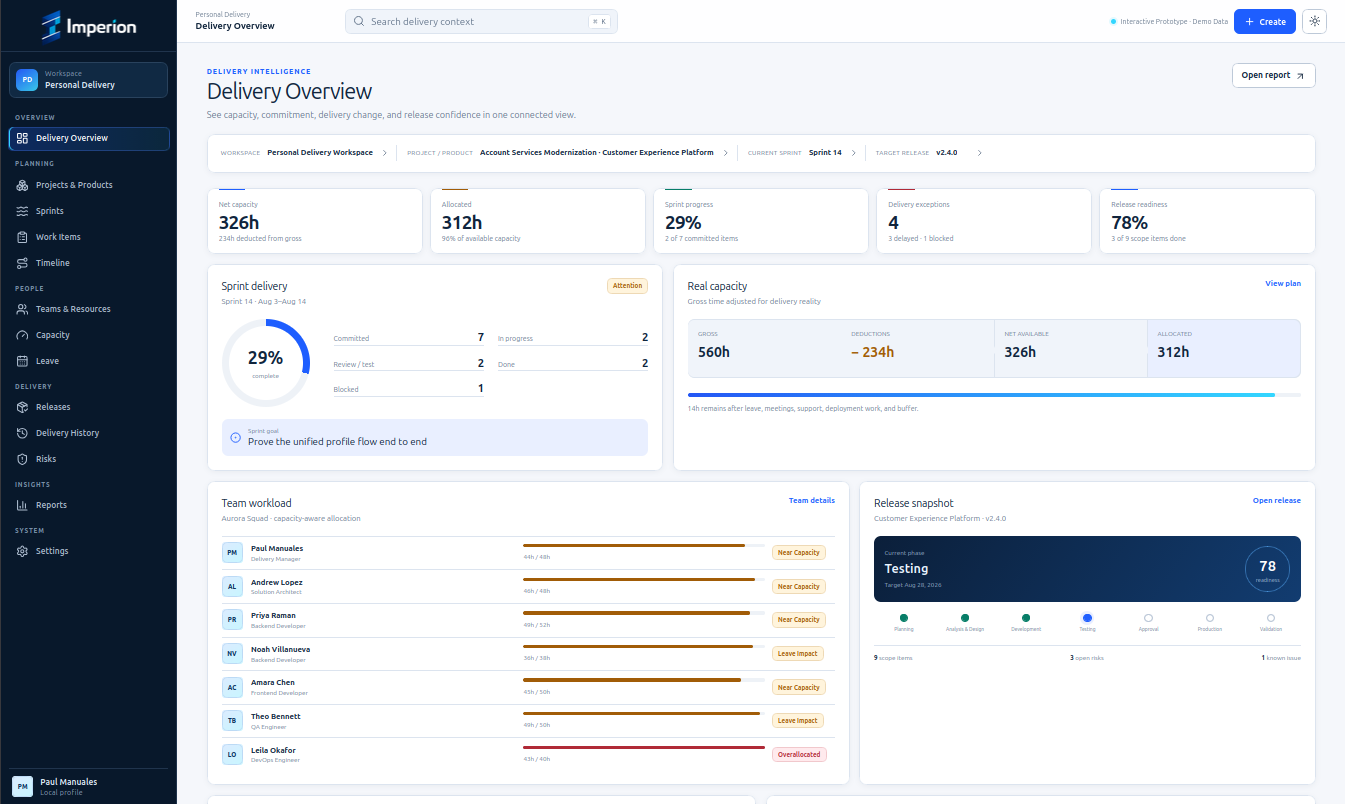
Real Capacity
Working days are not the same as delivery capacity. Imperion accounts for the commitments that actually consume available time—including leave, holidays, meetings, operational support, deployments, and other responsibilities.
Systems. Innovation. Impact.
EquilibrioTech is a systems-oriented technology initiative developing products, frameworks, and applied research that connect fragmented processes, information, and institutions—from enterprise delivery to smart cities and digital society.
Products · Systems Architecture · Applied R&D · Digital Society
EquilibrioTech
Digital transformation often begins by solving individual problems. Over time, organizations accumulate applications, processes, datasets, responsibilities, and technologies that work within their own boundaries but were never designed as parts of a larger whole.
EquilibrioTech explores a different approach: understand the system, preserve its context, connect what belongs together, and build technology around the relationships that matter.
Our work spans commercial software development, systems architecture, applied research and prototyping, smart-city and digital-society concepts, and public discussion around more coherent approaches to digital transformation.
Technology developed around practical operational and organizational challenges.
Frameworks, prototypes, proofs of concept, and long-horizon systems exploration.
Research into connected digital infrastructure for institutions, communities, and people.
Contributing technical understanding and systems thinking to conversations among government, industry, civic organizations, engineers, researchers, and builders.
Featured ProductWorking PrototypeIn Active Development
Enterprise Delivery Intelligence Platform
From Strategy
to Delivery.
Enterprise delivery rarely happens in one place. Strategy, requirements, architecture, planning, capacity, execution, releases, operational information, and reporting are often spread across different systems, spreadsheets, documents, and teams.
Imperion is being developed to preserve that connected delivery context—from the reason work exists to the outcome it is intended to achieve.
Working Prototype
A working prototype exploring connected delivery visibility across planning, capacity, work, risk, and release context.
Connected delivery context
Working days are not the same as delivery capacity. Imperion accounts for the commitments that actually consume available time—including leave, holidays, meetings, operational support, deployments, and other responsibilities.
Plans change. Imperion is designed to retain original estimates and dates alongside extensions, revisions, reasons, and their impact instead of replacing history with only the latest plan.
Delivery does not end when implementation is complete. Imperion connects work with releases, readiness, deployment, production validation, and the journey toward business value.
Understand why work exists, what it supports, how it changed, who can deliver it, when it can be released, and whether it ultimately achieved its intended outcome.
Product Roadmap
Imperion begins with the daily realities faced by delivery leaders while its architecture is being developed toward a broader enterprise platform.
Now
Teams, resources, sprints, work items, realistic capacity, leave, delays, delivery history, basic release planning, timelines, risks, and reporting.
Next
Forecasting, delivery analytics, baselines, flow metrics, risk visibility, richer reporting, and early Axiomate assistance.
Expanding
Deeper product and release intelligence, business demand, business analysis, architecture, portfolios, programs, governance, and service context.
Enterprise
Multi-user collaboration, enterprise identity, permissions, APIs, integrations, centralized deployment, and organizational governance.
Intelligence
Context-aware assistance for planning, capacity, delivery risk, release readiness, analysis, reporting, and decision support—while preserving human review and accountability.
Research · Concept Development · Prototyping
Beyond enterprise software, EquilibrioTech is developing and supporting an interconnected body of research exploring how digital systems might better represent and serve institutions, communities, citizens, and society itself.
At the center of this work is Paradiso—an evolving vision for a Digital Society Platform and a broader ecosystem of concepts investigating governance, information, participation, societal understanding, and human-centered digital infrastructure.
The Paradiso Platform connects to the Governa Framework. Governa connects to the SocietyPulse, Republic Commons, and Citizen Portal proofs of concept. Return Movement is philosophically and humanly connected to the wider Paradiso vision; it is not a Governa software module.
Digital Society Platform · Conceptual Development
An envisioned digital infrastructure exploring how information, participation, collaboration, institutions, communities, and human agency might become parts of a more coherent digital society.
Explore ParadisoFoundational Framework · Active R&D
Modeling society before building systems.
A governance-and-society modeling initiative built around a model-first principle: understand how institutions, jurisdictions, communities, public systems, information, and relationships are structured before designing the systems intended to serve them.
Governa is being developed as a foundational government-and-society information layer for the future Paradiso Platform.
Explore GovernaProof of Concept
Explores how the condition and trajectory of societies can be understood through multiple credible governance, development, peace, wellbeing, economic, environmental, institutional, and related measurement frameworks.
Explore SocietyPulseProof of Concept
Explores a configurable digital foundation for governance, public services, planning, participation, transparency, societal outcomes, and future evidence-informed decision support while preserving legitimate differences among jurisdictions.
Explore Republic CommonsProof of Concept
Explores a citizen-centered environment in which trusted public information, services, civic opportunities, and societal context can be organized around voluntarily supplied circumstances while preserving privacy, transparency, consent, and human agency.
Explore Citizen PortalMovement
The human and philosophical dimension connected to the wider Paradiso vision—exploring the values, consciousness, responsibility, and collective purpose that should accompany technological and societal transformation.
Explore Return MovementA Wider View
Digital transformation is often approached application by application, agency by agency, department by department, or problem by problem. Each solution may work within its own boundaries while the larger environment becomes increasingly fragmented.
EquilibrioTech is interested in what comes next:
systems that understand their context, information that can retain its provenance, technologies that can interoperate without erasing legitimate differences, and digital infrastructure designed around the people and institutions it is meant to serve.
This does not require forcing society into one application or one rigid model.
It means pursuing coherence instead of unnecessary fragmentation, interoperability instead of isolation, and integration without surrendering human agency, institutional responsibility, or legitimate diversity.
Starting environment
PhilippinesGrounded Here
EquilibrioTech is based in the Philippines, which serves as the starting environment for much of its thinking around digital transformation, smart cities, governance, public information, institutional systems, and emerging digital-society infrastructure.
The Philippines is not treated as a template that other societies must follow. Instead, it provides a real and complex environment in which ideas can be studied, modeled, prototyped, challenged, and improved before broader applicability is considered.
EquilibrioTech also seeks to contribute to deeper discussion around digital transformation among government leaders, civic organizations, industry, engineers, researchers, builders, and communities—particularly around the limitations of siloed approaches and the possibilities created by more coherent digital systems.
Our Principles
Five commitments shape how EquilibrioTech approaches products, research, and the systems they are intended to serve.
Understand the relationships behind complex problems before designing isolated solutions.
Explore through research, engineering, experimentation, and working prototypes.
Build around clarity, provenance, security, responsibility, and explainability.
Use technology to extend human capability—not quietly remove human agency.
Develop ideas with awareness that systems increasingly cross organizational, geographic, and societal boundaries.
People Behind the Work

Founder · EquilibrioTech
[PAUL CAREER PROFILE — TO BE SUPPLIED BY OWNER]
Beyond his professional work, Paul approaches technology from a systems-level perspective: the most consequential problems rarely exist in isolation, and meaningful progress depends on understanding the relationships among people, institutions, information, processes, and the environments they shape. This perspective connects the work across EquilibrioTech, Imperion, Governa, and the wider Paradiso research ecosystem.
His long-term interests extend from enterprise delivery and solution architecture to smart cities, digital society, civic systems, governance, and the responsible use of intelligent technology. He advocates for moving beyond siloed digital transformation toward systems that are coherent, interoperable, explainable, and centered on human agency—technology that helps people and institutions make better decisions without reducing them to components of the technology itself.
Paul sees EquilibrioTech as both a builder and a laboratory: a place to create practical products for today's problems while exploring deeper ideas about how digital infrastructure might better serve society tomorrow. The work is intentionally grounded in the Philippines while looking outward, with the belief that local understanding, responsible experimentation, and open collaboration can contribute to broader models for human development.
Underlying that work is a personal commitment to leave something useful behind: systems, ideas, and tools that can help people collaborate more effectively, strengthen communities and institutions, protect the planet on which future generations depend, and move society—however incrementally—toward a more humane, sustainable, and peaceful future. For Paul, technology is not the legacy itself; what matters is whether it helps leave the world better than it was found.